Potsdam, 16.06.2026
John Kent Remolador, Student an der Universität Potsdam, absolvierte in den vergangenen zwei Monaten ein Praktikum bei der DELPHI IMM. Er widmete sich dabei dem Problem der KI-gestützten Erkennung von Solarmodulen auf Dächern mithilfe von Luftbildern und weiteren Geodaten.
Hier nun sein eigener Bericht dazu:
John Kent Remolador
Universität Potsdam
I am a doctoral researcher in the field of geosciences and remote sensing at the University of Potsdam. As part of my PhD graduate program, I recently completed a 2-month Industry Secondment at DELPHI IMM.
Current energy policies, whether in the EU or at the state level, promote the rapid expansion and adoption of renewable sources, notably including solar energy. DELPHI IMM aims to support this endeavor by proposing geoinformation solutions that could supplement existing efforts to monitor the State of Brandenburg’s renewable energy generation and consumption. In line with this objective, I worked on a project where I developed an automated framework to map and estimate the number of photovoltaic modules within a given area, which integrates machine learning and image processing methods.
For this project, I mainly relied on sub-meter resolution digital orthophotos (DOP) acquired from aerial surveys. High pixel resolution of the images were necessary in order to easily identify solar modules, which are harder to do from images of most currently-operational satellites (e.g., Sentinel-2 images). To automate the mapping process, I implemented a machine learning approach programmed to identify image pixels that represent the solar modules. I specifically developed a model called the U-Net, which is a type of machine learning tool that uses complex neural networks and is ideal for tasks involving images. To build a functional U-Net, I needed to train the model with sample DOP images paired with manually-delineated label images. The goal was to make the model capable of identifying solar modules from images based on the patterns it learned from the training data it was fed with. I tested different combinations of the input image layers (i.e., red, green, blue, infrared, elevation, edges) to come up with a model with the most optimal performance. After producing models that were able to delineate the locations of photovoltaic modules, I devised an algorithm to count the number of individual modules. This used edge-detection techniques to differentiate the separate units before counting them.
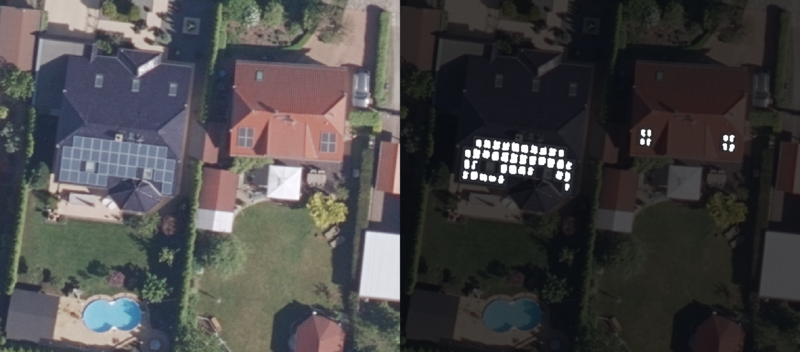
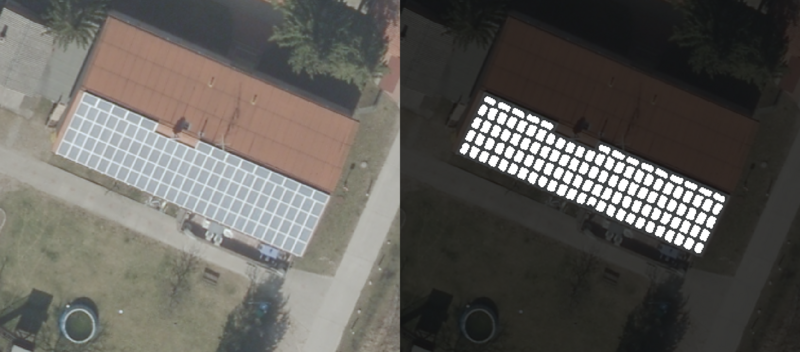
I tested this framework on two chosen test sites, Kleinbeeren and Trebbin. Figures 1 and 2, respectively show sample results from these sites. Through a combination of U-Net target delineation and edge detection, the developed framework is shown to generate a final map identifying individual modules in an automated manner. General assessment of the results for these test sites show some limitations on the framework’s performance, which were expected due to the limited training data available. In particular, glass roofs and greenhouses were found to be common false positives (misidentification) while modules on shaded roofs and modules with uncommon designs were often false negatives (failed identification). Just like most other AI models, these issues can be mitigated through further training on the U-Net model using additional and more diverse training data.
With the aid of this framework, attempts to quantify the surface area of installed photovoltaic modules becomes easier and more streamlined. This can be useful in many use cases, such as estimating the power generated from solar energy within a neighborhood, or for determining the installed capacity of different solar parks across the state.
This project is made possible by the INITIATE Doctoral Network, funded by the European Union Marie Skłodowska-Curie Actions.